


To handle diverse projects, Butcher Bird must constantly build new, flexible workflows to send and receive video signals from the stage across the facility, using AJA routing and connectivity.
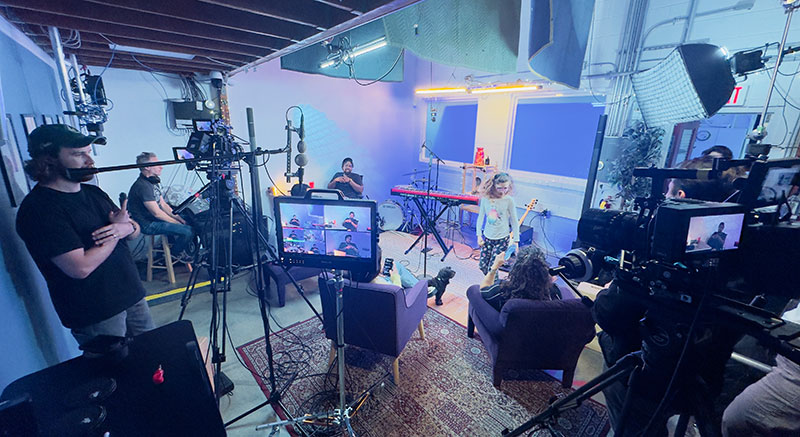
Working on today’s live streams, virtual productions and immersive media is technically ambitious, but it still requires studios to bring together their talent, creativity and the right supporting technology. Butcher Bird Studios in Los Angeles balances those factors with a team of 10 skilled, adaptable people and a robust workflow.
They carry out a range of projects from original intellectual property (IP) to traditional interview setups, large-scale livestreamed events, virtual productions and immersive VR experiences. The company has delivered 180° and 360° VR media for clients including Meta and BuzzFeed, and worked with Canon to document best practices for 180° VR filming and post production.
Fast, Reliable Signal Access
Successful productions, whether studio-based or remote, depend on flexible signal routing, low-latency I/O and redundancy.
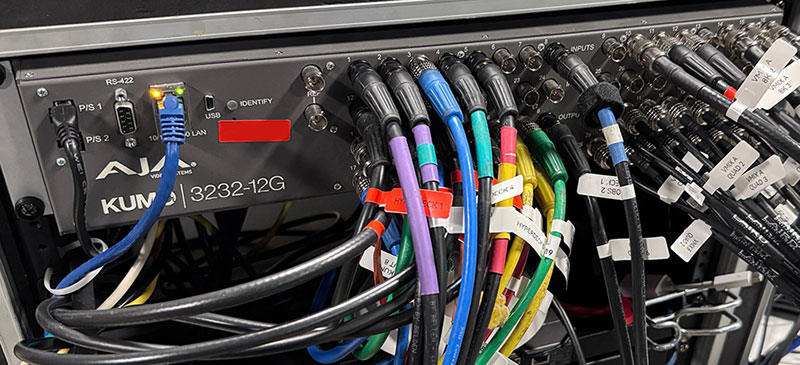
Having such a diverse slate of projects means Butcher Bird spends a lot of time building and testing new workflows. Their operation requires the flexibility to send and receive video signals across the facility from the stage to green rooms, offices, creative suites and elsewhere. To simplify signal flow, the team works with AJA KUMO 12G-SDI and 3G-SDI Routers, including one KUMO 3232-12G, one KUMO 1616-12G and one KUMO 1616 (3G-SDI).
Quick access to signals is especially in demand for the special monitoring set-up the team suspends from their stage ceiling grid. They mount stirrups to the grid to hang TVs about 6 to 8ft (2m to 2.5m) above the ground. Through this build, producers, talent and crew can monitor shoots live, without having to crowd around a single screen.
"KUMO routers are a natural fit for what we do. They're fast, dependable and easy to operate. Their web UI is great for keeping signals organised," said Technical Director Brian Druckman. "The hardware strikes the right balance between industrial – working no matter what – and being easy to use. It also introduces very little latency, which keeps everything feeling responsive for operators, talent and audiences.
KUMO Salvos for Redundancy
For redundancy, Butcher Bird relies heavily on pre-saved routing tables known as salvos. Primary and backup vMix systems are run for every project, so if the main system fails, the team uses salvos to instantly re-route the backup to the right destination. "KUMO salvos are super simple to set and forget," Brian noted. "Once configured, we can trust our backup will work, which gives us peace of mind."
Because vMix is not able to trigger external software and hardware, they need to set up third-party tools like Bitfocus Companion to trigger actions to their networked devices, such as the AJA KUMO. “If my vMix hardware only has four SDI inputs, but my show requires five or more camera feeds, I can use an Elgato Stream Deck running Bitfocus Companion to talk to the KUMO and hot-swap the camera feeds that are being routed to my four SDI IN-ports,” Brian said.
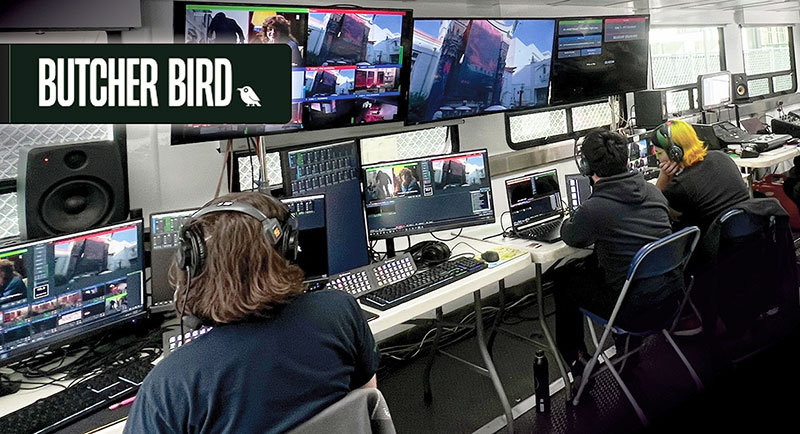
“The main advantage of a tool like Companion is that I can map multiple actions to multiple devices from a single button press. Generally, the way I would program this would be to run a full screen transition graphic in vMix, wait half a second for the screen to be fully covered, and then change the SDI routing in the KUMO so the correct feed will be visible when the transition ends – all under one button press.
“To allow switching inside of vMix, you can have up to four hardware (SDI/HDMI) and four networked (NDI/SRT) outputs and those output feeds can in turn be independently assigned to inputs and switched on the fly.”
As well as KUMO, Butcher Bird often brings an AJA Io 4K Plus capture and output device on remote projects to support external Thunderbolt I/O for encoding setups. It allows them to keep their footprint small by connecting to laptops or compact systems running OBS or vMix, instead of large workstations. Brian has found Io 4K Plus useful when the team needs to add just one or two extra inputs, and it often serves as their I/O for final encoding and delivery.
Precise Coordination in Real Time
Maintaining signal path integrity proved critical for a recent multi-camera green screen virtual production shoot with live compositing. They employed a three-camera 4K workflow with the cameras a little over 5 and a half feet tall, putting the talent's eye-lines just slightly above camera, while the Butcher Bird team positioned monitors around the stage displaying live views of the performance with the composited imagery
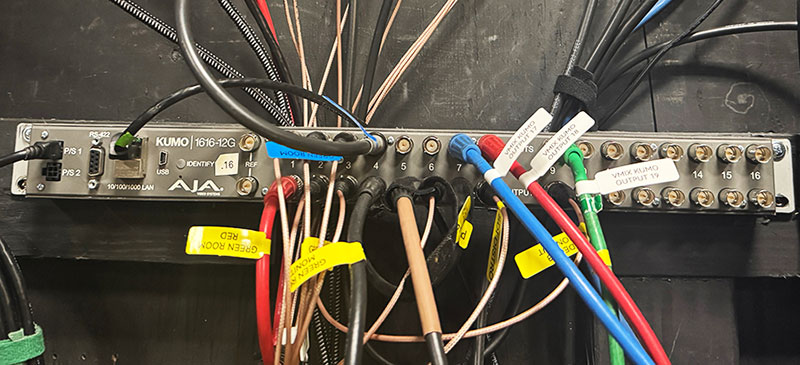
The views gave the actors a chance to react in real time. The workflow required precise coordination across the stage. Every signal – from camera ISOs to composited outputs and isolated backgrounds – had to be routed through to monitors, other displays and recorders across the studio, for which Butcher Bird deployed AJA KUMO 3232-12G routers.
"The KUMOs were essential for us on this project. They allowed us to maintain a continuous, low-latency production environment, even as we sent the composited feeds to the monitors and recorders," Brian noted. "Without the flexibility and reliability of KUMO, this workflow would have been challenging to execute. AJA gear lets us keep all our signals organised both in-studio and while working remotely."
In the future, Butcher Bird plans to expand its virtual, live and immersive capabilities. As it does, incorporating emerging remote production and AI technologies into its studio and remote pipelines will be a central focus. Regardless of the new technologies and techniques it adopts, Brian will continue to depend on AJA technology to maintain the video routing and I/O stability that the studio's projects demand. www.aja.com