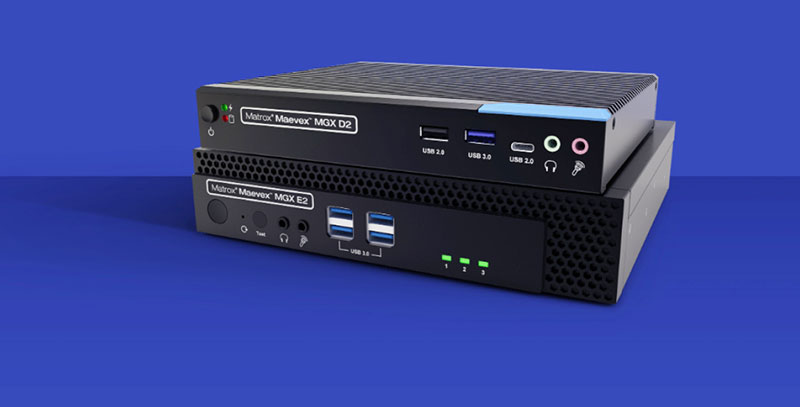



TAG is participating in the MXL interop initiative at NAB, joining a live project hosted by AWS and exchanging streams with participants including Grass Valley, Matrox and Techex.
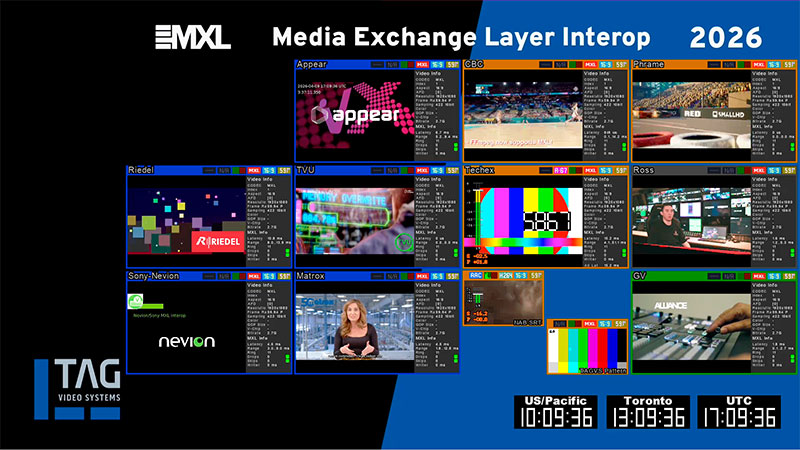
TAG Video Systems, developer of integrated IP probing, monitoring, visualisation and analytics software, has announced its participation in the Media Exchange Layer [MXL] interop initiative. TAG has joined relevant MXL and DMF committees and is currently taking part in a live multi-vendor interop project, hosted by AWS and exchanging streams with participants including Grass Valley, Matrox, Techex and others.
MXL and DMF Development
Media Exchange Layer, or MXL, is an emerging open-source media transport standard, developed through broad industry collaboration and first published as a stable specification in early 2026. It moves video, audio and metadata through direct memory transfer rather than packet-based streaming, running natively across any IP environment without PTP dependencies. MXL sits within the broader Dynamic Media Facility (DMF) framework, which enables fully software-defined broadcast production. Both are in the early stages and advancing quickly.
For broadcasters, the practical outcome is the ability to build software-defined facilities that are no longer tied to fixed physical infrastructure. These virtual control rooms and production workflows can be deployed, reconfigured and scaled based on what is actually needed, when it is needed. Critically, MXL is a cloud enabler, making uncompressed workflows in the cloud more efficient, and making it possible for more companies to take advantage of the cloud environment.
“In effect, MXL alleviates the inherent latency of ST 2110. In the application, no CPU time is spent on formatting and timing of 2110 packets. Not only can transport accelerate beyond real-time, but more compute power is available for the application,” said Michael Demb, Vice President of Product Strategy, TAG Video Systems.
Active Participation in Interoperability Testing
MXL and DMF are built on an IT-centric architectural model, which aligns naturally with how TAG has generally approached product development. TAG's platform is software-native and built to integrate across complex multi-vendor environments. However, this integration can only exist if TAG is present where the standards are being shaped, which is why active participation in MXL development, including the interoperability testing that defines how this standard works in practice, makes a difference.
TAG’s participation in MXL is straightforward. As production environments become more software-defined and dynamically orchestrated, the tools customers rely on for monitoring and quality control need to work in those environments as well. TAG has an initial working MXL implementation and is using the interop phase to test, validate and refine this implementation alongside other vendors, building the interoperability that customers will need when they make this transition.
At NAB 2026, visitors can see their collective work in action at the AWS stand where TAG is part of the live multi-vendor MXL interop demo. tagvs.com