Digital Domain’s DDAI Brings AI-Integrated Infrastructure to Visual Storytelling
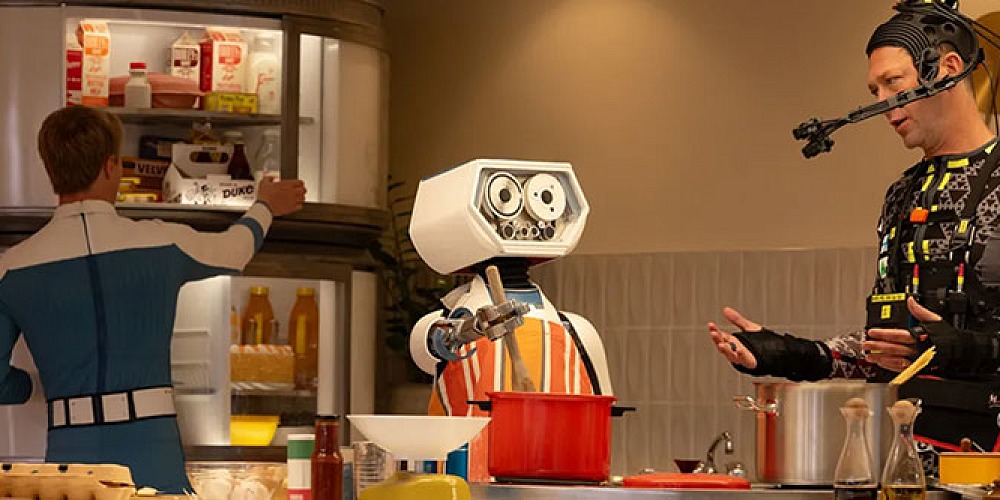
Digital Domain’s DDAI is specifically designed to meet the demands of film and episodic production, combining the precision of CGI pipelines with the expression of generative AI.
Digital Domain has appointed VFX Supervisor and Art Director Jelmer Boskma bringing credits on projects including Star Wars: Andor, Marvel's Eternals and Guardians of the Galaxy Vol. 2.
Autodesk’s Maya, 3ds Max and Arnold updates combine new AI features with improvements like a procedural RBD workflow for Bifrost and automated horse motion in MotionMaker.
Nuke 17.0 introduces native Gaussian Splat support, launches a new USD-based 3D system, expands machine learning capabilities, and extends its Machine Learning tools.
VFX studio JFX has expanded its senior creative leadership team with the appointment of Ingo Putze as VFX Supervisor and Jenn Epstein as Associate VFX Supervisor.
Digital Domain hired Pete Dionne as Visual Effects Supervisor, recognised for his technical expertise, creative leadership and strong record in digital creatures and complex CG environments.
Foundry’s acquisition of Griptape will help speed up its AI strategy by augmenting Foundry's AI-based features with orchestration capabilities for better customisation and control.
Katana 9.0’s native USD support gives lighting artists flexibility and control over lighting in USD workflows for scenes of any size, while maintaining data integrity all along the pipeline.
Maxon's new release of Cinebench is updated to the most recent Redshift Rendering engine and adds support for the new NVIDIA and AMD GPUs, and M4/M5 Apple Silicon processors.
Chaos Vantage's real-time feedback is now accessible in the viewport, speeding up layout, previs and lookdev for VFX and animation teams, alongside a new set of updates for V-Ray 7 for Houdini and Maya.
GenAI Generalist Sami Ling at Dimension Studio shares interesting ideas on the role of AI in filmmaking, particularly in virtual production, reflecting her experience gained at the studio.
Mari 7.5 has a new Multi-Paint feature developed as a collaboration between Foundry and Wētā FX, a Texture Transfer system, an expanded asset library and an Image Manager.
Many thanks to everyone who has entered the AEAF 2020 Awards. All winners are listed below along with all finalists. It’s been wonderful to see so much terrific work from so many teams – judging is the challenge. The hard part this year is not being able to say congratulations and thanks in person. We are missing tremendously the chance to say hello, screen the showreel and have a drink with everyone at the Chauvel Cinema. It’s always a great event! We’re already looking forward to next year.
But - we hope you enjoy seeing the finalists and winners reel online. If your project is among the winners, although you won’t be able to pose for the camera and take your prize home with you, we will make sure your trophy is delivered as soon as possible. We will contact all winners shortly.
{media id=1193,layout=solo}
AEAF Awards finalists and winners
Feature Film
The Lion King - MPC Film - GOLD
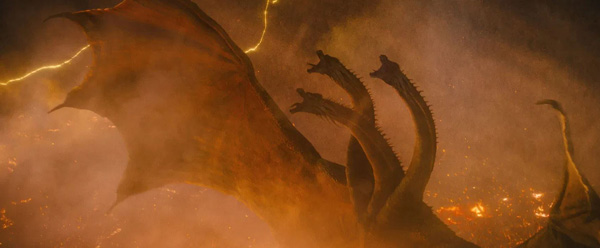
Godzilla: King of the Monsters - MPC Film - SILVER
Jumanji: The Next Level - Weta Digital - BRONZE
The Addams Family - Cinesite - BEST FEATURE FILM - ANIMATION
Jumanji: The Next Level - Method Studios - BEST SEQUENCE
Ford V Ferrari - Rising Sun Pictures - SPECIAL MERIT
Lady and the Tramp - Weta Digital - SPECIAL MERIT
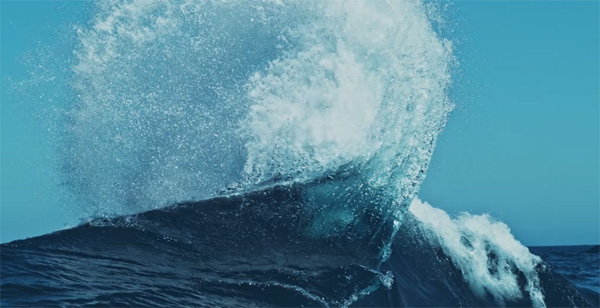
The Aeronauts - Framestore Pokémon: Detective Pikachu - Framestore Avengers: Endgame - Framestore Lady and the Tramp - Framestore Underwater - MPC Film 1917 - MPC Film Lost in Russia - Fin Design and Effects Call of the Wild - MPC Film Terminator: Dark Fate - Method Studios IT Chapter Two - Method Studios The Invisible Man - Cutting Edge The Aeronauts - Rodeo FX Crawl - Rodeo FX 100% Wolf - Flying Bark Productions
TV Series
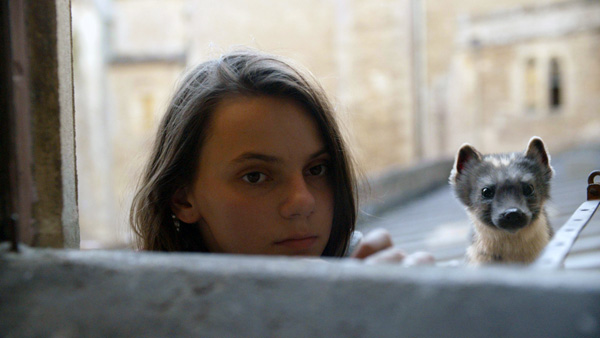
His Dark Materials - Framestore - GOLD
The Witcher - Cinesite - SILVER
Stranger Things - Season 3 - Rodeo FX - BRONZE
Happy! Season 2 - Axis Studios Operation Buffalo - Blackbird The Commons - Blackbird Lost in Space: Season 2 - Cinesite Cosmos : Possible Worlds - Fin Design and Effects The Witcher - Framestore Watchmen - Dr Manhattan sequence - Framestore Glitch: Season 3 - Future Associate Reef Break - Future Associate Miss Scarlet and the Duke - Screen Scene
Commercials Animation
The Time Shop - Psyop - GOLD
DICK's Sporting Goods - The New Kid - MPC - SILVER
Magic The Gathering - Throne of Eldraine - Axis Studios - BRONZE
AA Insurance - Dinosaur vs Unicorn - Alt.vfx Teleflora - The Elf - Alt.vfx Sounds Like Triple M - Cadre Pictures Coca-Cola - Clay Dolls - Fin Design and Effects Libresse - #WombStories - Framestore Hug Insurance - Have a Hug - Hank Mango King Living Innovation - MISTER Samsung - Awesome Is For Everyone - MPC Eurostar - You See More When You Don’t Fly - MPC Kosciouszko - Beer with Altitude - New Holland Creative Uniqlo Park - New Holland Creative The Guardians - Passion Paris Productions Football Federation Australia - Where Heroes Are Made - Passion Pictures Erste Group - #HannaBumblebee - Passion Pictures Wagamama - Bowl to Soup - Passion Pictures ENI - PlusOne Apple - psyop Travel Oregon - psyop Lamps - The Post Bangkok co.ltd. Unionpay - VANDAL
Commercials VFX
EasyJet - Hide and Seek - MPC - GOLD
Toyota - Shortcut - Framestore - SILVER
Asus - Zenbook - Fin Design and Effects - BRONZE
RMA - The Search - Collider - SPECIAL MERIT
Living Innovation - Blackbird Domuts - Blackbird I Touch Myself - Collider The Journey of Mankind is the Sea of Stars - Dans Digital Adidas - Ozweego - Fin Design and Effects TAB - Spotlight - Fin Design and Effects Weltmeister - Maven - The Birth - Fin Design and Effects LEGO - Drive What You Love - Framestore WSJ - Read Yourself Better - Framestore Apple - Bounce - Framestore KIA - 7 years in 7 seconds - Glassworks Amsterdam GMC Sierra - Juice G2A - Juice Lexus - LF30 - MPC Postmates - When All You Can Pizza Is Think About - MPC Lexus - Hybrid International - MPC Argos - The Book Of Dreams - MPC Kanebo Kate - New Holland Creative Clear Vietnam - Smoke & Mirrors Toyota Highlander - Heroes - Alt.vfx Taco Bell - Xbox One - Alt.vfx KIA Sorento - Black Edition - Heckler SK-II - The Legend of Pitera - Heckler Kraken - VANDAL Nasonex - VANDAL
TV Series - Children
Raising Dion Season 1 - Rodeo FX - GOLD
Lego City Adventures - Season 1 - Passion Pictures - SILVER
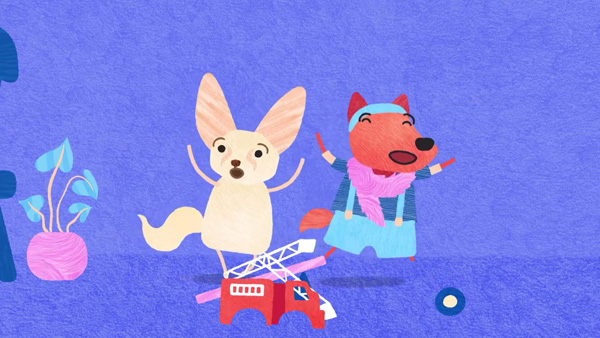
Alphabet Street - Paper Moose - BRONZE
Are You Tougher Than Your Ancestors? - Sticky Pictures & Flying Kite Pictures SPECIAL MERIT
The Gamers 2037 - Game Master - Ambience Entertainment Kiri and Lou - Sugar - Kiri and Lou The Strange Chores - Media World Pictures Pty Ltd/Ludo Studio
Live Event Installations & Projections
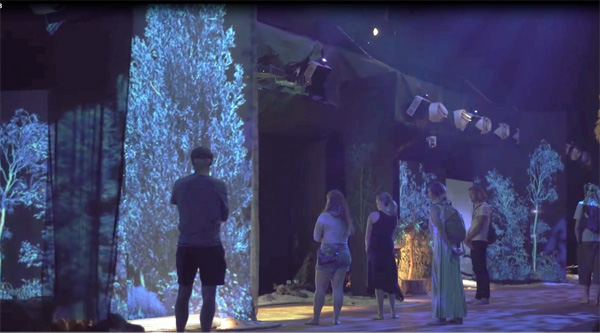
Enlighten Canberra Architectural Projections - The Electric Canvas - GOLD
Victoria - Animism Studios - SILVER
Act V of the Exhibition Thierry Mugler: Couturissime - Rodeo FX - BRONZE
Yabarra - Dreaming in Light (2020 Adelaide Fringe) - Monkeystack - SPECIAL MERIT
NRL State of Origin In-Stadium Pre-Game Show Content - Hank Mango Glastonbury 2019 - Heckler City of Melbourne Christmas Festival Projections - State Library of Victoria - The Electric Canvas Animal Planet - Into The Blue - MISTER
Web / Viral
Sealy Haynes - MISTER - GOLD
Latitude - Let's - Heckler - SILVER
Zotac - MiniPCs - Jumbla - BRONZE
Save Freddo - Cadre Pictures Tropeaka Protein Bars - Motion Lab
Education & Infographics
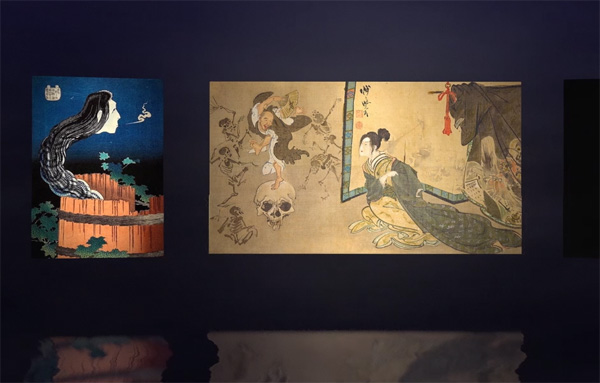
Art Gallery of NSW Japan Supernatural Exhibition Educational Primer - Hank Mango - GOLD
Sydney Living Museums: Surveillance - Collider - SILVER
General Motors Next Generation Global Architecture - GM (Holden) Design Synraysia Drain Relining - GRAMM Batavia - Royal Australian Mint - Its Got Stealth Project Firestorm - Jumbla Anglo American - New Holland Creative Dispute - Robert Grieves Disorder - Robert Grieves
Music Video
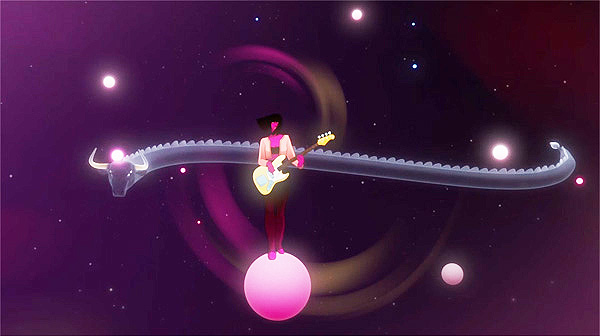
The Rest of My Days - Passion Paris Productions - GOLD
Khruangbin - Pelota - Glassworks - SILVER
Slipknot - Unsainted - Rodeo FX - BRONZE
Persian Empire - She Got Confused // He Wouldn't Sleep - Conlan Normington Let's Pretend! - Jessica Edge
Idents & Stings
Australian Chamber Orchestra 2020 Season Launch Campaign - Substance - GOLD
Foxtel UHD Foxsports - VANDAL - SILVER
Spotify - Spotify - Passion Pictures - BRONZE
Foxtel UHD Movies - VANDAL
Studio Promo
Aliens - Revolution - GOLD
PlusOne Manifesto - PlusOne - SILVER
Stella - Passion Pictures - BRONZE
CGI Interlinked - Catalysee London Fox - Jumbla
Titles/Openers
Atlanta’s Missing and Murdered - Framestore - GOLD
World in Motion - Triada Studio - SILVER
The Unlisted - Kinetika - BRONZE
Standing Up For Sunny - Substance - BEST FEATURE FILM TITLE
The Gamers 2037 - Opening Titles - Ambience Entertainment The Bush Years - Family Duty Power - David Penn Perspective Shift - Taste Creative Be Natural: The Untold Story of Alice Guy-Blache - PIC Agency & Be Natural Productions
Interactive, VR Experience, Augmented Reality
City of Melbourne - Christmas Compass - Red Cartel - GOLD
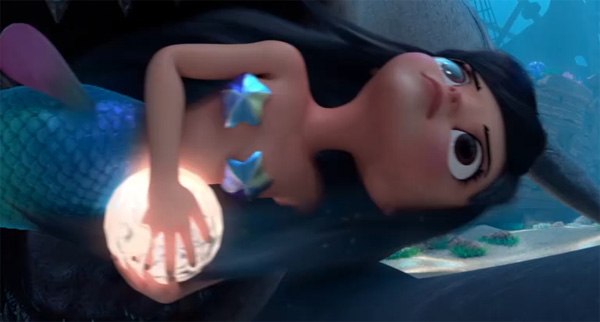
Mermaid - The Mysterious Pearl - Untitled Studios - SILVER
Subaqua - UTS Animal Logic Academy - BRONZE
WISE - Curiious Bahrain NBN - New Holland Creative Virtual Chicken - TAFE NSW - Poultry Hub - Red Cartel Syngenta - Educational VR for corn growth and treatment - Red Cartel Samsung Galaxy ExplorAR - Traffik and Chaos Theory World Square - Golden Week - VANDAL
Short Film
Bounty Hunter - UTS Animal Logic Academy - GOLD
Kino Ratten - Media Design School - SILVER
Tomorrow’s On Fire - Passion Pictures - BRONZE
SEALAND - Greenhouse Production
Game Trailers
Magic: Legends - Plastic Wax - GOLD
Apex Legends - Crypto - Passion Pictures - SILVER
Boomerang Fu - David Smith Animation - BRONZE
Corporate Video
DOLBY Vision - See The Unseen With Alexander Semenov - Juice - GOLD
The Beauty - Pascal Schelbli - Filmakademie Baden-Württemberg - GOLD
Any Instant Whatever - Michelle Brand - Royal College of Art - SILVER
Chocolate Man - Murat E Gönültas - Filmakademie Baden-Württemberg - BRONZE
ALBI - Rory Hulme - AIT Cleaning Time - Reece Mulley - AIT Pen, ink, paper and inkstone - Cheng Lei Plague - James Dickson - AIT Patience - Andrea Supandi - JMC Academy Malediction and Murder - Natalie Haig
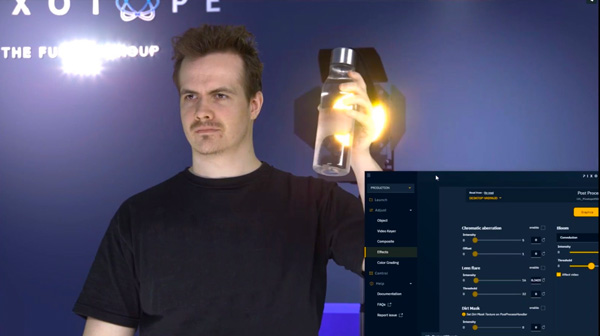
Pixotope, the live photo-realistic virtual production system from The Future Group, now runs on version 1.3 software, updated to help creators improve interactions between their virtual environments and the real-world elements.
Pixotope forms the central production hub when creating mixed-reality (MR) content for broadcast and live events, and has tools that help producers bring together physical components, such as presenters, actors, props and free-moving cameras, effectively with virtually created assets such as backgrounds, graphics, animated characters or any other CG elements. Version 1.3 has new object tracking and lighting integration functionality, and more control over colour management.
The Future Group’s Chief Creative Officer Øystein Larsen said, “The success of a mixed reality scene depends on the relationship and interactivity between real and virtual components. Part of this success depends on technical accuracy, such as matching lighting, replicating freely moving cameras and precise, invisible keying. But there is also an emotional aspect which flows from enabling presenters and actors to freely express themselves through unrestricted movement, and interacting with virtual objects as they would real objects. Version 1.3 of Pixotope improves on results in both of these areas.”
Using Real-time Tracking Data
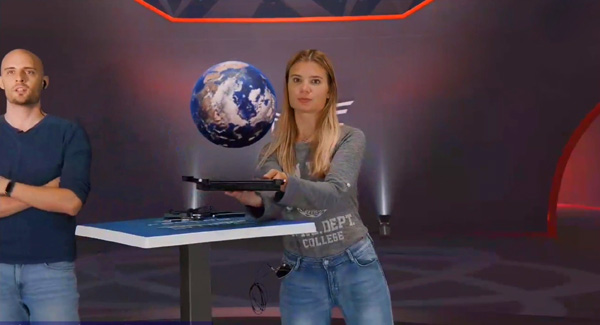
A major advance is in the ability to integrate and use data from real-time object tracking systems. This allows Pixotope to use the positions of moving tracking locators in the real world environment and attach them to digitally created objects, so that those objects can be made to follow the tracked motion. This means presenters can pick up and rotate graphics or any other virtually generated asset in a natural, expressive manner, opening many more creative possibilities. From showing a 3D model in the palm of their hand, to controlling any aspect of a virtual scene with their own physical movement, presenters and actors become free to interact with the virtual world around them.
Another advantage of Object Tracking is that presenters themselves can be tracked, so that Pixotope is continuously aware of where in the scene they are. A challenge in normal virtual studios is that presenters must be careful about where they stand and when. Presenters cannot walk in front of graphics that have been composited over the frame, for example. However, when accessing an object's position and orientation through Pixotope’s Object Tracking interface, Pixotope recognises where the presenter is relative to the position of other generated items within three dimensional space and handles the occlusions accordingly. Actors are free to walk in front, behind or even through virtual objects.
Matching Lights and Colour
Also new in Pixotope Version 1.3 is the ability to control physical lights using DMX512 over the Art-Net distribution protocol. This enables Pixotope to synchronise and control any DMX controllable feature of physical studio lights with controls from the digital lighting set-up used to illuminate virtual scenes. As a result, light shining on the real set will match the light in the virtual scene. Lights can then either be driven via an animation pre-set, or by using a new Slider widget available for user-created Pixotope control panels. These panels can be accessed via a web browser on any authorised device and be operated either by a technician or the presenter.
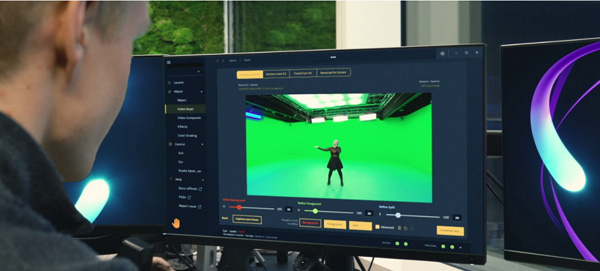
Pixotope Version 1.3 also further improves the results of chroma keying for green screen studios with new functions that help extract greater detail, like fine strands of hair and shadows. New algorithms process key edges to sub-pixel accuracy, improve colour picking and automate the reduction of background screen colour spill.
Colour Management control can now be accessed in Pixotope’s Editor Viewport to make sure that artists working in any practical colour space, including HDR, feel confident of the colour fidelity of the images they are creating.
Pixotope is natively integrated with the Unreal game engine, and in Pixotope 1.3 all the new functions in UE Version 4.24 are available to users. The changes include layer-based terrain workflows that help create adaptable landscapes, dynamic physically accurate skies that can be linked to actual time-of-day, improved rendition of character hair and fur, as well as increased efficiency for global illumination that helps to create photo-real imagery. www.futureuniverse.com
Nuke 12.2 builds on updates in Nuke 12 so far, and adds a new product to the Nuke software series for compositors. Named Nuke Indie, the new software is a functionally restricted version of Nuke Studio that independent artists can use on commercial projects, and is limited to one seat per user or organisation earning less than $100,000 per year.
It aims to make Nuke’s tools more accessible to people working outside a post production studio. It combines the node-based compositing functionality of NukeX with the conform, editorial and review capabilities in Nuke Studio. It also extends the reach and adds to the community of Nuke users.
Although Nuke Indie can’t be used in a pipeline with other Nuke licenses, commercial or indie, all Nuke and NukeX nodes, including WriteGeo and Primatte, are contained in the package, with all supported Nuke Studio conform and editorial functions. It is compatible with most formats and codecs except AAC compressed audio and H.264/AVC video, and you can send your video out to work on an external monitor.
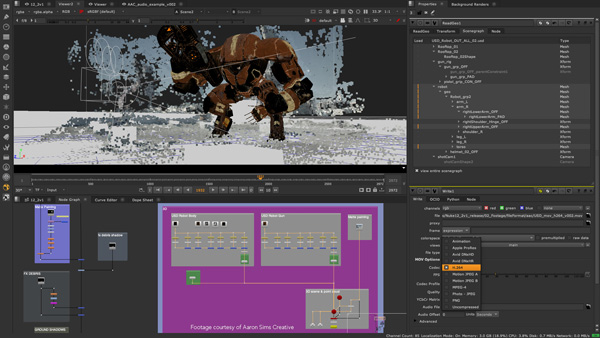
Nuke 12.2 (screenshot Aaron Sims Creative)
Nuke Indie can be used to read commercial Nuke and Hiero scripts, build simple Python integrations and use BlinkScript in the timeline and nodegraph – although Python API support is limited. Among the functional limitations are Nuke Indie’s encrypted file format (.nkind/.hroxind/.gzind) and 4K render resolution. Also, NDK and 3rd party plug-ins are not supported, and external rendering is disabled.
Users receive regular maintenance updates and licensing support, and are granted access to a community forum specifically for Indie users. The software is available as an annual subscription, purchased online.
USD Support, Sync Review, License Roaming
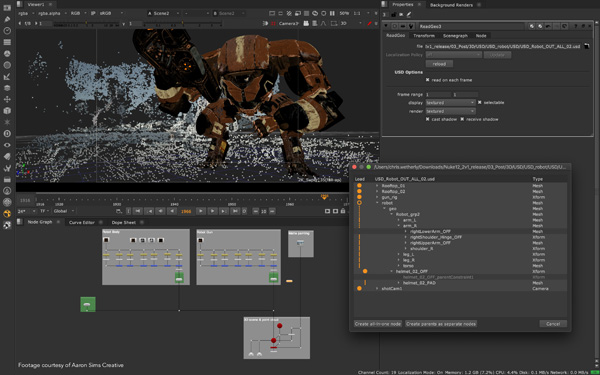
Native support for USD via the Read Geo node.
The Nuke updates in 12.2 is the third release of Nuke 12. One of version 12’s main drivers has been the artist experience – the UI is more interactive, and it has monitor support for high DPI images and a more stable, consistent Shuffle node. Also, data can be moved more easily into compositing due to better format support and EXR performance and, for Nuke timeline-based tools, the playback engine is rebuilt to view multiple shots in context in Nuke Studio and Hiero.
Now in 12.2, Nuke adds native support for USD, which will allow artists to read USD data using Nuke’s ReadGeo node and work with USD collections in the same way it reads other 3D formats. They can work with geometry contained within the USD with a specific scenegraph UI, support for normals, colour data and animated geometry.
Sync Review
These extensions to ReadGeo will be open sourced, making it possible to integrate the updates into custom USD tools. This initial support should also make it easier to experiment with using USD in Nuke. Studios already using USD can adapt this node to build up a more integrated user experience.
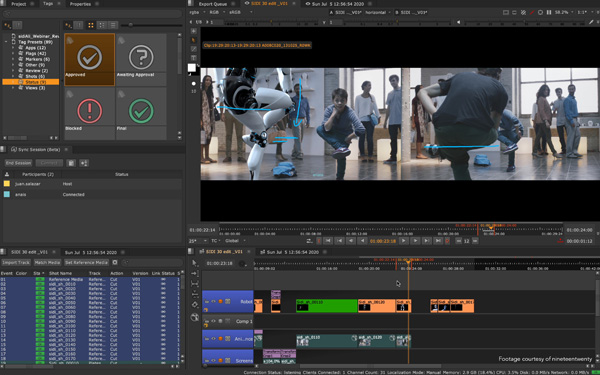
A beta feature in Nuke 12.2 is Sync Review. This first Sync Review implementation will allow Nuke Studio, Hiero and HieroPlayer users in multiple locations to review and annotate footage collaboratively. Each participant has access to the playback controls, annotations and version system during collaborative review sessions. The number of users and resolution is limited by hardware and bandwidth only. To set up a session, footage needs to be available for all participants either locally or through a central server, connecting to network storage, cloud storage like DropBox, or localised files.
Collaborative review sessions in Sync Review.
Foundry plans to extend the function further but for now, Sync Review will support teams working remotely. Push updates, like text messages and mobile alerts, are there to help users to stay in sync with the session. The Hiero API has been extended for viewer control, project loading and saving so that users can customise their own synced workflows. Note that, because Nuke Indie does not have access to Beta/Alpha releases, Indie users won’t be able to use Sync Review.
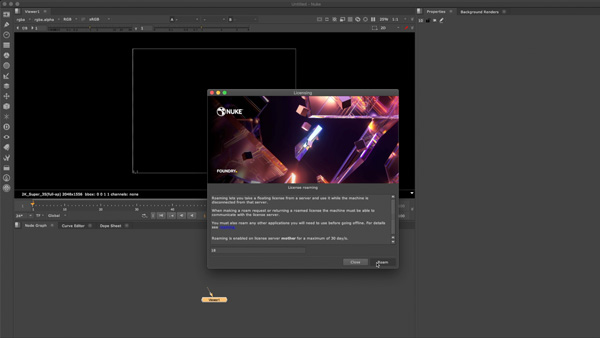
New License Roaming is available to users with active maintenance of Nuke, NukeX, Nuke Studio and Hiero, and means they can check out licenses from floating licence servers to use offline for up to 30 days at a time, for example, when going on set or working remotely.
License Roaming
Nuke 12.2 has a new MOV Reader and Writer, replacing the previous 32-bit and 64-bit QuickTime support with a more stable and flexible system for working with QuickTimes. QuickTime codec support, especially H.264 encoding, will be extended across operating systems but some of the older QuickTime codecs will no longer be supported.
Exporting DNxHR .mov files has been added to all Nuke software, and DNxHR MXF support is added to Nuke Studio and Hiero. This gives the timeline products the same functionality that was added to Nuke in Nuke 12.1. Nuke Studio, Hiero and HieroPlayer will now also support reading and playback of AAC encoded audio tracks. Nuke 12.1 supported .mov containers holding audio to Linux and Windows, which made it unnecessary to extract and import the audio as a separate Wav file. www.foundry.com
AEAF’s virtual event is taking place in just under one month. The Speaker Program line-up has grown to cover topics ranging from VFX and animation in TV shows and movies to learning how to wrap your pipeline around USD on a student budget. We are now also hard at work judging the wonderful entries to the AEAF Awards. We will soon announce the Finalists and cut the Showreel to be screened online this year for the very first time.
REGISTER to attend on your favourite screen on 14 August. See more detail about the Speakers here.
The speakers you will see and hear at AEAF this year are presenting from all over the world – Canada, the US, London and Australia – and from diverse backgrounds, and all are dedicated to visual stories and a love for film.
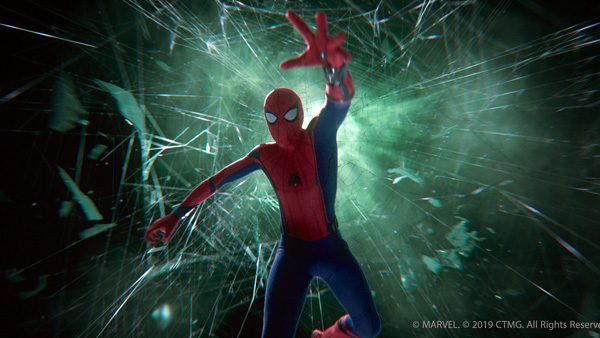
Alexis Wajsbrot, who has also co-directed his own film, will take you on Framestore’s winding journey with Marvel to conceive and create the illusion battle Spider-Man fights with Mysterio in 'Spider-Man: Far From Home’.
Robert Bock from Rodeo FX, is in fact an accomplished Director of Photography and now holds the special role of Head of Live Action studio at Rodeo. His photographer's eye also made him the ideal candidate to supervise VFX for ‘Tales from the Loop’, translating paintings to the TV screen.
FX Lead Luke Gravett and Character FX and Crowd TD Chelsea Shannon are talking from not one but two Animal Logic studios, Sydney and Vancouver, about how they worked their way into the roles they now fill developing tools and pipeline for feature animation projects.
DNEG’s Ben Wiggs working life has been devoted to VFX animation for 17 years, starting with commercial stories at MPC to, most recently, treading that fine line between mechanical and human motion in robots for ‘Westworld’ 3, the topic of his talk.
Nelson Sepulveda-Fauser is one of the ILM team responsible for de-aging the principle actors to help tell the story in 'The Irishman', and will talk about his team’s work on the project, an Oscar nominee, from the perspective of 16 years at ILM.
As a VFX TD who enjoys getting his hands dirty, Technical Lead Daniel Flood at UTS ALA will demonstrate how teams can start using USD, one of the fastest growing developments in VFX today, as the basis of their pipeline, from Shotgun integration through lighting and automated rendering – all without breaking the budget.
AEAF Awards’ Feature Film categories, VFX and Animation, have received the most varied lineup of entries yet. It is also very big. Everyone devoted to filmmaking – artists, animators, producers and directors – is invited to tune in and watch the AEAF 2020 showreel on 14 August, which will include breakdowns and before/after clips of many of these projects. Among them are superhero blockbusters and monster thrillers from the major studios, plus independent titles from around the world, a feature documentary and kids’ movies.
Unfortunately, several of the vendors are not able to post their VFX reels publicly in AEAF’s online section, nevertheless the work is beautiful and seeing them in the AEAF lineup is really exciting.
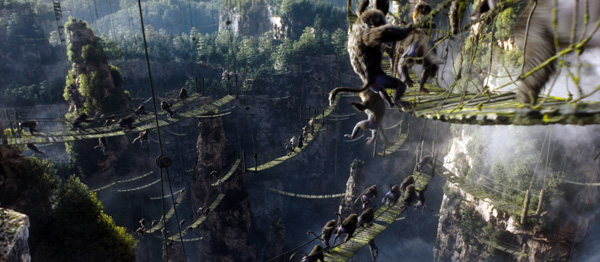
Weta Digital 'Jumanji: The Next Level'
It’s great to have a chance to see VFX and animation from more than one vendor on the same film. Look out for work from Method Studios and Weta Digital on ‘Jumanji: The Next Level’, Framestore and Weta Digital on ‘Lady and the Tramp’, and Rodeo FX and Framestore on ‘The Aeronauts’.
Virtual production was a critical factor in two of the movies from MPC, ‘The Lion King’ and ‘1917’. Not only did their work result in tremendous visualisations of the film’s stories but the projects became important R&D opportunities for more productions of this kind in the future.
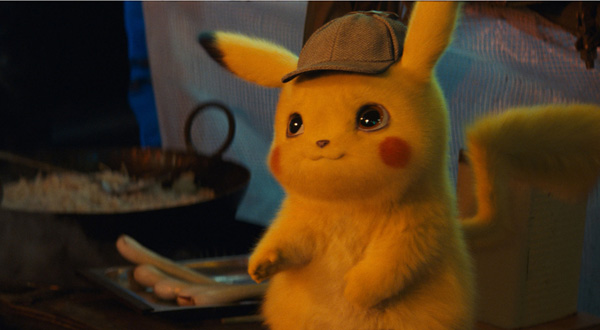
Framestore ‘Pokémon: Detective Pikachu’
Amazing talent for photoreal animals and creatures that play starring roles is evident in several entered projects - ‘Lady and the Tramp’, ‘Call of the Wild’, ‘The Lion King’, ‘Pokémon: Detective Pikachu’, 'Jumanji: The Next Level' and more.
Terrifying monsters like MPC's 'Godzilla: King of the Monsters' are one thing but horror is another – although judging by the monster builds and animations by the artists at Rodeo FX for ‘Crawl’, Method Studios for ‘IT Chapter 2’, Cutting Edge for ‘The Invisible Man’ and MPC for ‘Underwater’, the line between them is very fine. The edge of your seat will be the safest place to watch from.
Fin Design 'Lost in Russia'
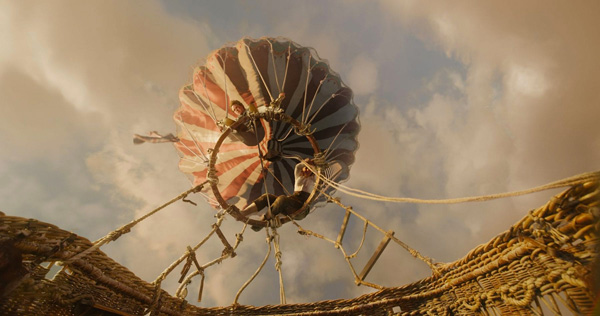
Environments are the stars in some of the projects including – among other – RSP’s race track in ‘Ford v Ferrari’, a hot air balloon’s view of the English countryside for ‘The Aeronauts’ by Rodeo FX and Framestore, wild Africa made by MPC for ‘The Lion King’ and the vast Russian winter under moonlight in ‘Lost in Russia’ created by Fin Design. This last movie, made by filmmaker Xu Zheng in China, only just missed a theatrical release after the COVID-19 health crisis closed all cinemas in China. It was made available for free viewing over producer Huanxi Media’s streaming platform.
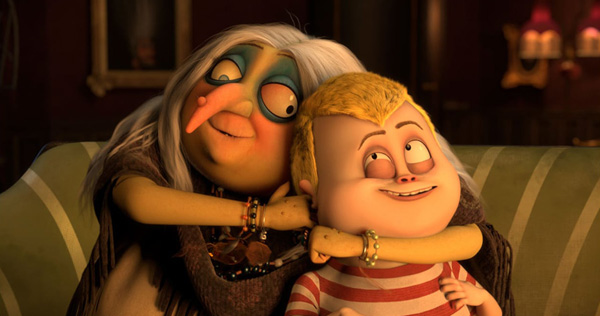
Animated features for children – and grownups who love animation – bring great stories to life in ‘100% Wolf’ by Flying Bark Productions, ‘The Addams Family’ produced by Cinesite and ‘Upin & Ipin: The Lone Gibbon Kris’ from Les' Copaque Production in Malaysia. These three projects have very different animation styles and stories, and represent a huge amount of work.
Cinesite 'The Addams Family'
Since inspiration and courage are essential for all aspiring filmmakers, you will find both in abundance in a documentary feature film titled ‘Be Natural: The Untold Story of Alice Guy-Blaché’ from PIC Agency & Be Natural Productions. Alice Guy-Blaché (1873-1968) was the first female filmmaker and wrote, produced or directed 1,000 films during her career. The footage for this project is mainly archival, resulting from 8 years of research, and also includes work from an animation team.