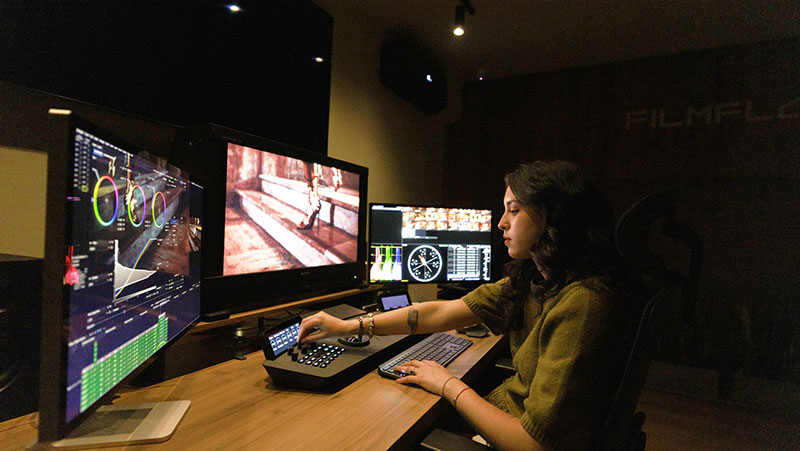


Park Jin-ho talks about grading No Other Choice on Baselight with the director and DP, who wanted to convey the story and emotions not only through images, but by using colour itself.
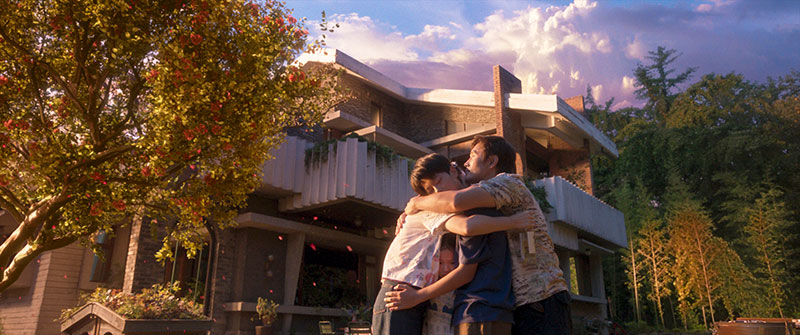
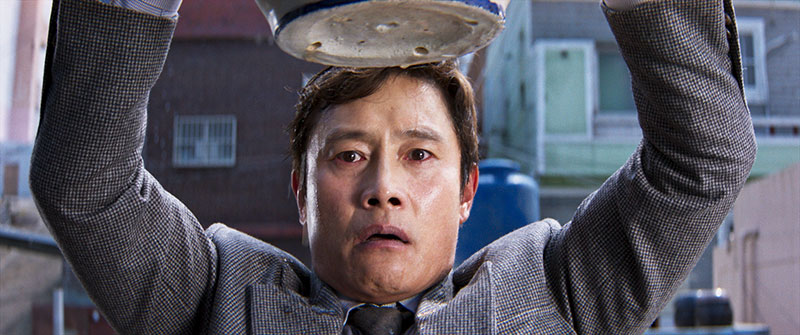
In No Other Choice (2025), protagonist You Man-su is a paper-industry expert who is abruptly laid off after 25 years. He resorts to eliminating his job-seeking rivals in a desperate attempt to support his family.
The movie, directed by Park Chan-wook and shot by Kim Woo-hyung, premiered at the Venice International Film Festival in August and was released in South Korea in September.
Park Jin-ho at Cinemate in Seoul, South Korea, was responsible for the colour grade. Director Park Chan-wook said, “I had previously collaborated with Kim Woo-hyung on The Little Drummer Girl, and with Park Jin-ho on Thirst and The Handmaiden. Knowing their abilities well from those projects, I didn’t hesitate to be bold and courageous, and push even further in working on this film.
Looking for the Look
“My requirements were demanding. But rather than blindly clinging to vaguely defined conventions of what is often referred to as ‘film look’, I wanted to begin with a clear and precise understanding of what that means. To that end, we conducted a comparative test, shooting the same subject under identical lighting conditions using both film and digital cameras. Building on that data and maximising the advantages of the digital camera, such as the detail inside the shadow – we strove for a look that is classic but full of detail, and elegant while defined by bold, striking colour.
“Such a look seemed almost impossible to achieve. But ultimately, we tried to achieve my ambition of conveying the story and emotions not only through images, but through colour and contrast itself.”
“I’ve worked with cinematographer Kim Woo-hyung many times, so there’s a natural rhythm to our collaboration,” said colourist Park Jin-ho. “He frequently shares reference stills and behind-the-scenes material, creating a continuous dialogue that helps us refine the direction. Having studied filmmaking in the UK, he often brings highly specific international references, which allows us to establish a visual approach very quickly.
“With our director Park Chan-wook, discussions went beyond look development and extended into camera movement. Techniques such as handheld motion and roll effects were often shaped during the grade itself. These camera movements, applied in post, became an important tool in emphasising the director’s creative intent.”
Building Authenticity
Park Jin-ho was involved from the pre-production stage, and the central goal for the creative team was to recreate an authentic film aesthetic.
“We carried out extensive tests,” explains Park Jin-ho. “Park Chan-wook and Kim Woo-hyung even explored the option of shooting on actual film, running a 400-foot test. In parallel, I tested various film textures using scanned grain material from my own library.
“We also considered the Livegrain plugin, which works in Baselight, as one of the approaches. After evaluating all of the options, Livegrain proved to deliver the most convincing texture and dimensionality for our characters, so it became the final choice.”
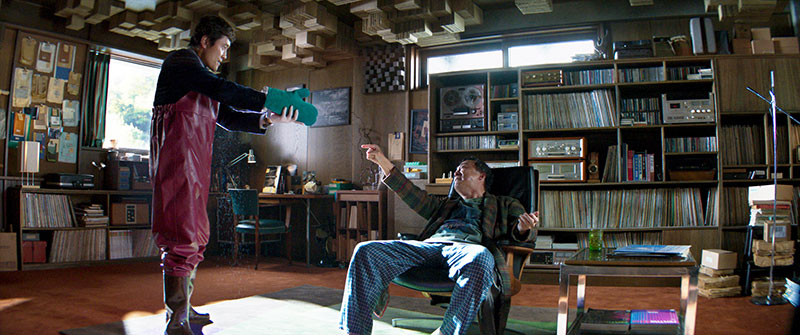
During the shoot, Park Jin-ho created four to six LUTs that were used as needed depending on the lighting or narrative situation, but this was done mainly for reassurance on set. “In the final grade, we stepped away from the LUTs and began again from the raw material. Both the director and cinematographer brought numerous visual references to the table, and the three of us compared a wide range of styles before arriving at the finished look.”
Language of Light
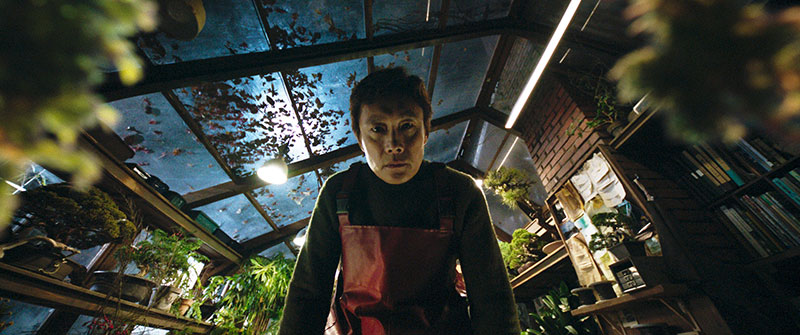
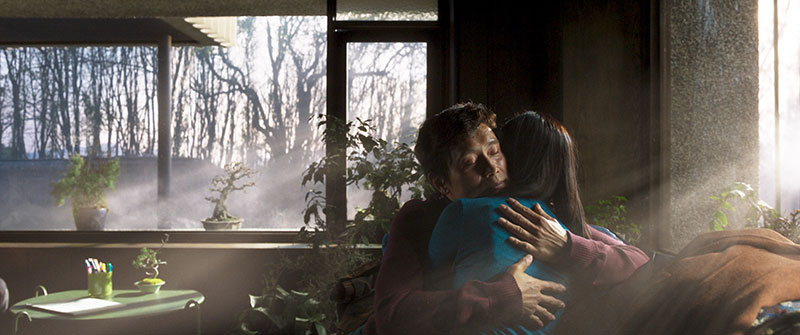
Park Jin-ho’s guiding principle was to avoid warm tones wherever possible. “Naturally, scenes like sunsets required warmth for emotional clarity, and in those moments we embraced it,” he said. “The director places enormous value on the details of mise-en-scène – props, set design, texture – and we carried out a great deal of secondary work in the grade, shot-by-shot, to highlight or suppress specific elements.”
Another key focus was sculpting facial features in light to enhance the characters’ dimensional qualities.
“The opening scene, when the main character is overwhelmed by sunlight reflecting into his eyes during a job interview, was especially memorable,” Park Jin-ho remarked. “The director wanted the glare to feel almost like a projection mishap. Although theatrical projection tops out at around 48 nits, we pushed the effect as far as technically possible. In Dolby Cinema, with HDR, the result was particularly striking.”
Baselight Tools and Stability
Park Jin-ho worked on No Other Choice on a Baselight grading system. He has been using Baselight for around 22 years now, since the early 2000s. “Baselight’s timeline-based interface has always been simple and intuitive,” he said. “The autosave function is incredibly reliable, which gives me a great feeling of security. I do use other systems, but having previously lost projects on some of them, Baselight’s stability is one of the key reasons I continue to choose it.”
For him, another of Baselight’s greatest strengths is its transparency and feature set. “Both the lead colourist and the assistant can understand the state of a project instantly, even when working at different times, so that collaboration requires virtually no explanation,” he said.
“The face-tracking tools, D-Key for secondary work and Baselight’s colour separation capabilities are exceptionally powerful, too,” he noted. “In many respects, they outperform other systems quite decisively.” He likes using the D-Key to select and isolate specific colours in an image for secondary grading, especially for complex selections with multiple colours that involve adding and subtracting similar hues with varying luma levels.
From Digital to Film Look
As Park Chan-wook, the director, mentioned above, Park Jin-ho also found achieving a genuinely film-like look from digitally captured material was one of his biggest challenges as a colourist. “Both the director and our cinematographer Kim Woo-hyung have extremely high standards when it comes to film texture and contrast,” he said.
“We also aimed to give the images a sense of weight and density, adding grain and texture while consistently steering away from warm tones. Balancing Livegrain to ensure a natural, cohesive feel required a great deal of precision as well.” Users need to composite different exposures of a gray chart – representing the different grain assets with associated luminance ranges – onto the digital image.
Colour Spaces
One of the most memorable aspects for Park Jin-ho on this movie was delivering the project across multiple colour spaces – P3 DCP, Dolby Cinema (108 nits), IMAX and Netflix HDR.
“The Dolby Cinema grade stands out above all,” he said. “As our facility couldn’t project at 108 nits, I travelled to Dolby’s studio in Los Angeles to complete the work. We uploaded around 20TB of data beforehand to ensure a quick start. Seeing the Dolby Cinema image for the first time was astonishing—its brightness and vividness were almost reminiscent of an HDR display.
“Maintaining the director’s concept consistently across all formats required substantial time and care, but it was immensely rewarding.”
“In today’s OTT-driven landscape, the classic cinematic look is becoming increasingly rare in Korea,” commented Park Jin-ho. “This project – where direction, cinematography, production design, performance, music and colour work aligned so organically – felt truly cinematic, and that made the process especially enjoyable.”
Following positive reviews, worldwide distribution of No Other Choice is planned for early 2026. www.filmlight.ltd.uk